- English
- French
- German
- Portuguese
- Spanish
- Russian
- Japanese
- Korean
- Arabic
- Greek
- German
- Turkish
- Italian
- Danish
- Romanian
- Indonesian
- Czech
- Afrikaans
- Swedish
- Polish
- Basque
- Catalan
- Esperanto
- Hindi
- Lao
- Albanian
- Amharic
- Armenian
- Azerbaijani
- Belarusian
- Bengali
- Bosnian
- Bulgarian
- Cebuano
- Chichewa
- Corsican
- Croatian
- Dutch
- Estonian
- Filipino
- Finnish
- Frisian
- Galician
- Georgian
- Gujarati
- Haitian
- Hausa
- Hawaiian
- Hebrew
- Hmong
- Hungarian
- Icelandic
- Igbo
- Javanese
- Kannada
- Kazakh
- Khmer
- Kurdish
- Kyrgyz
- Latin
- Latvian
- Lithuanian
- Luxembou..
- Macedonian
- Malagasy
- Malay
- Malayalam
- Maltese
- Maori
- Marathi
- Mongolian
- Burmese
- Nepali
- Norwegian
- Pashto
- Persian
- Punjabi
- Serbian
- Sesotho
- Sinhala
- Slovak
- Slovenian
- Somali
- Samoan
- Scots Gaelic
- Shona
- Sindhi
- Sundanese
- Swahili
- Tajik
- Tamil
- Telugu
- Thai
- Ukrainian
- Urdu
- Uzbek
- Vietnamese
- Welsh
- Xhosa
- Yiddish
- Yoruba
- Zulu
How does a PVC Pipe Profile Crusher compare to other types of crushers?
Many procurement managers who are looking at PVC pipe recycling equipment wonder how specialized PVC pipe profile crushers compare to other machines. Several important factors determine the answer: accuracy, throughput, energy efficiency, and the need for upkeep. PVC pipe profile crushers are very good at working with the unique shape and qualities of polyvinyl chloride pipes, producing particles of a uniform size with little dust. Compared to dual-shaft shredders or general-purpose plastic crushers, these specialized units improve blade contact and chamber design for rigid pipe structures, which means they use less energy per ton of material produced. Leading PVC pipe crusher factories, such as Hangzhou Xingbiao Machinery, have improved these designs over many years of careful research. They have added features like quick-change screens and stress-relieved steel frames that lower downtime and increase operating longevity.
Understanding PVC Pipe Profile Crushers and Their Working Principles
PVC pipe profile crushers are highly precise machines that turn used pipes, profiles, and other polyvinyl chloride materials into materials that can be used again. At their heart, these machines are made up of a spinning blade assembly inside a reinforced steel chamber and fixed counter-knives that cut the material that comes in into uniform pieces.
Core Components and Design Elements
The crushing chamber is made of high-strength steel plates that are bonded together and then given a stress-relief treatment. This keeps the steel from twisting even when it is under constant high loads. The rotating blades are made from SKD-11 or D2 cast steel that has been vacuum-heated and cooled so that the surface hardness is higher than HRC 58. This metalworking method makes sure that the metal doesn't wear down easily, even when working with fiberglass-reinforced PVC or pipe pieces that have mineral layers on them. The rotor shaft is usually made from T7A tool steel and is dynamically adjusted to reduce vibration. Heavy-duty bearings that are sealed against dust entry extend the time between repair intervals.
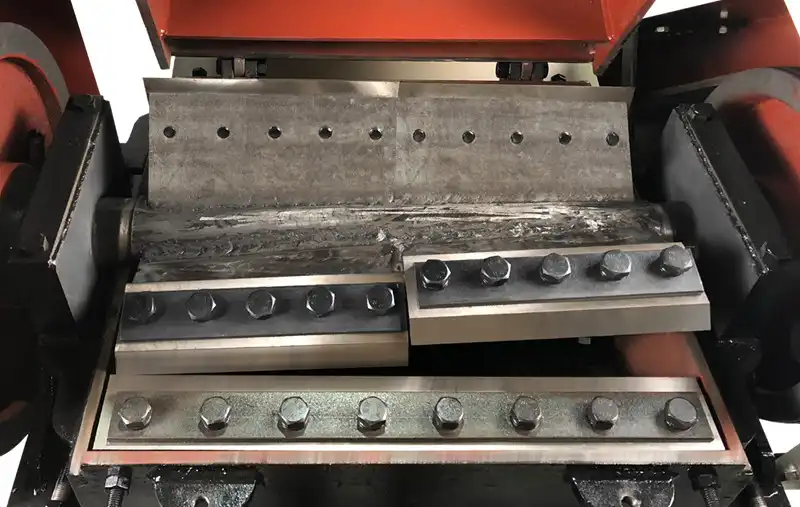
Screen units under the rotor control the size of the particles that come out. The mesh holes range from 6 mm for coarse flake to 2 mm for fine granulate. Quick-release clamps make it possible for workers to switch screens without taking the chamber apart. This cuts down on the time it takes to change materials during campaigns that use more than one material.
Step-by-Step Working Principle
The material goes into the hopper either by gravity or a conveyor link. As the pipes fall into the crushing chamber, they are pushed against fixed blades on the chamber wall by the high-speed rotor, which spins at 400 to 600 revolutions per minute. The pipes are broken into large pieces by this first hit. These pieces are broken up even more by subsequent passes through the rotor-stator gap, until particles small enough to fit through the screen holes leave through a discharge chute. A fan device removes fine dust, which keeps things clear and keeps equipment further down the line from getting dirty.
The throughput changes as the rotor width and motor power change. Small recycling operations can use compact models that can process 200 kilograms per hour, while large manufacturing plants that make a lot of trash pipe can use industrial units with 75-kilowatt drives that can process 1,500 kilograms per hour.
Maintenance Best Practices and Safety Guidelines
Blade checking and screen cleaning are important parts of routine maintenance. Every 40 hours of use, operators should rotate or flip the blades to reveal new cutting areas and check the cutting edges. By replacing old blades before they break, you can avoid uneven particle size and motor stress. Screen mesh needs to be cleaned once a week to get rid of the fines that build up and stop movement, which raises the temperature inside the room.
Access to the chamber is limited by safety interlocks while the rotor is spinning, and emergency stop switches must be placed so that they can be reached easily from the feed hopper. During high flow, decibel levels near the discharge chute can go over 85 dB, so operators should wear earplugs. Every month, dust collection systems need to be checked to make sure the filters are still working properly. This keeps PVC dust from building up, which can cause explosions in static-charged areas.
Comparing PVC Pipe Profile Crushers with Other Types of Crushers
To choose the best breaking technology, you need to know how different machine designs deal with the shape, thickness, and brittleness of PVC pipes. Dual-shaft shredders, granulators, and hammer mills are three popular machines that can be used instead of specialized PVC pipe profile crushers. Each has different trade-offs when it comes to speed, particle regularity, and how hard it is to run.
Efficiency Metrics and Throughput Characteristics
PVC pipe crusher factories use PVC pipe profile crushers that use a fast machine with special blade shapes that make the most crushing force per kilowatt-hour. According to independent tests, these units use about 0.45 kilowatt-hours per kilogram of crushed PVC pipe, while dual-shaft shredders use 0.62 kilowatt-hours for the same job. The profile crusher is more efficient because it can work on the whole diameter of the pipe at once, while shredders use slower intermeshing wheels that grab and tear material in several passes.
Granulators have a knife-rotor design that works best with soft thermoplastics, so they have trouble with stiff lines when they are used for injection-molded parts and film. Granulators often get stuck and blades chip when they have to work with PVC lines, which lowers their useful throughput by up to 30 percent. Even though hammer mills are strong, they make too many fines and too much heat, which breaks down the chemical structure of PVC and makes recovered material less useful for high-grade uses.
Particle Size Uniformity and Energy Consumption
For extrusion and injection molding steps that come after, getting particles of the same size is very important. When PVC pipe profile crushers are used with measured screens, the coefficients of variation are less than 15%. This makes sure that the melt flow is regular during reprocessing. Dual-shaft shredders make a bigger range of fragment sizes, but larger pieces need to be crushed again, which takes more work and uses more energy. While hammer mills make the smallest particles, they don't make them evenly distributed. Instead, they make a bimodal distribution with both big shards and sub-millimeter dust.
How much energy a business uses has a direct effect on its costs and its effect on the earth. Optimized PVC pipe crushers from specialized makers have variable-frequency drives that change the motor speed based on the load at any given time. This cuts the power used when the machine is not in use by 20% compared to designs with set speeds. This smart control also makes motors last longer by keeping them from getting too hot during starting and stopping.
Maintenance Complexity and Operational Downtime
Different types of crushers have very different maintenance needs. Bolt-on blades can be changed on PVC pipe profile crushers through open access panels. This means that a trained worker can change all four blades in less than two hours. To get to worn knives in a dual-shaft shredder, you have to take apart the whole rotor unit, which takes eight hours of downtime and special tools. Because they wear down so quickly, hammer mill screens need to be replaced more often than profile crusher screens, whose meshes last an average of 1,000 hours of use.
Total cost of ownership is affected by how easy it is to get replacement parts. Established makers keep regional distribution centers stocked with screens, bearings, and blades so that they can ensure next-day delivery. This framework for logistics cuts down on unplanned downtime, which is a competitive edge for businesses that work multiple shifts.
Selecting the Right PVC Pipe Crusher Factory for Your Business Needs
Working with a trustworthy manufacturer guarantees access to tried-and-true technology, quick expert help, and clear business terms. There are dozens of PVC pipe crusher factories in the world, but only a few have the certifications, customization options, and service facilities that make long-term relationships possible.
Factory Certifications and Quality Assurance
Leading makers have ISO 9001 approval for quality management systems and CE marking for machinery safety, which show that they follow international rules. In addition to basic certifications, look for companies that test the hardness of the blades, the stability of the welds, and the safety of the electricity. Before shipping, Hangzhou Xingbiao Machinery puts each crusher through a 48-hour continuous-run test. This test simulates production conditions and looks for possible failure modes.
OEM Capabilities and Customization Options
Standard catalog models are good for most uses, but when production needs are different, custom solutions are often needed. Customization options for companies include changing the shape of the hopper, the size of the screen, the voltage of the motor, and the inclusion of the control system. The engineers at Xingbiao work with customers to make crushers that work well with current conveyors, dust collectors, and robots that move materials. This consultative method makes installations easier and speeds up the time it takes to start using them.
Customization includes how the blades are set up. For plants that work with hard PVC schedule 40 pipe, strong tooth profiles work best. For plants that work with thin-wall conduit, finer-pitched blades are needed to keep the pipes from breaking too easily. Experienced companies keep blade files with dozens of tried-and-true shapes. This way, they can match the features of the material to the tooling without having to do expensive prototypes.

After-Sales Support and Global Service Footprint
Technical help that is quick to respond affects how long equipment lasts. Check that any potential sellers have service hotlines filled by experts who can speak more than one language and do remote diagnostics through a video link. Hangzhou Xingbiao promises to answer emails within 24 hours and sends techs to sites where major problems are happening that are affecting production plans.
Logistics for spare parts need to be looked at closely. Blades and screens can be sent by fast delivery from factories with stores in North America. Components will arrive within 48 hours. If, on the other hand, sellers only use inventory from other countries, wait times can be up to three weeks because of customs clearance and foreign freight.
Market Pricing and Payment Terms
The price of PVC pipe crusher factories PVC pipe profile crushers depends on how much they can crush, how well they are built, and how well-known the brand is. Models that can handle up to 200 kilograms per hour start at about $8,000. Models that can handle more than 1,000 kilograms per hour range from $28,000 to $45,000. Base prices go up by 15 to 25 percent for extras like automatic screen changers, sound-dampening casings, and sensors that can predict when repair needs to be done.
Payment terms usually call for a 30% deposit to be made when the order is confirmed, and the rest to be paid before the shipment. Established sellers may be able to negotiate net terms of 60 or 90 days, but only after their liquidity has been checked. Leasing through third-party financial companies lets businesses that don't have a lot of cash on hand keep their cash flow going while using new tools.
Case Studies: Successful Implementations of PVC Pipe Profile Crushers
By looking at real-world deployments, we can see the real benefits that come from choosing the right tools and working with reliable providers.
Mid-Atlantic Recycling Plant Boosts Throughput by 40 Percent
A local recycler that dealt with used plumbing trash had trouble getting the job done because their old dual-shaft shredder got stuck on hard PVC sewer pipe a lot of the time. The plant put in a 55-kilowatt PVC pipe profile crusher with SKD-11 blades and a 6-millimeter screen after talking to experts from Xingbiao. Throughput went from 450 kilograms per hour to 630 kilograms per hour in the first month, while energy use went down by 18%. Maintenance intervals were pushed back from every two weeks to once a month, which gave workers more time to do other things. Within 14 months, the recycler got its money back from lower labor costs and more sales of recycled materials.
Injection Molder Integrates Crusher for In-Line Scrap Recovery
A Tennessee company that made PVC irrigation fittings made 200 kg of gate scrap and broken parts every day. Before, scrap was stored in Gaylord boxes and sent to outside recyclers every three months, which used up working capital and cost money in hauling fees. The company put in a small profile crusher next to its injection molding cell. This crusher regrinds scrap right away so that it can be put back into the hopper at a 15% loading level. This closed-loop method got rid of the need for dumping fees, cut the use of virgin resin by 12%, and made the plant cleaner. The noise level of the breaker was low—68 dB at one meter—so it could be put in the work area without soundproofing.
Pipe Manufacturer Achieves ISO 14001 Compliance Through Energy-Efficient Crushing
An extrusion company in California that makes Schedule 40 PVC pipe wanted to get ISO 14001 environmental approval, which meant that they had to cut their energy use and trash going to landfills by a certain amount. Three old hammer mills were replaced with two PVC pipe profile crushers that have variable-frequency drives and built-in dust collectors. Size reduction used 54,000 kilowatt-hours of power a year instead of 87,000 kilowatt-hours a year, and 98 percent of trash was diverted from landfills as crushed scrap was used instead of new material. The measurable environmental benefits helped the company pass ISO 14001 tests and improved its image with customers who care about the environment.
Final Recommendations and Best Practices for Procurement
To find the right balance between initial cost, daily efficiency, and long-term dependability, you need an organized decision-making framework that puts measurable performance criteria ahead of initial price.
Conducting Cost-Benefit Analysis
The total cost of ownership includes the price of the machine, the energy it uses, the work needed to keep it running, extra parts, and downtime. To figure out the payback period, divide the extra cost of the crusher compared to a lower-level option by the amount of money you'll save each year on energy and work. Most owners who look for high-quality tools and strong building see their money back in 18 to 30 months. Think about how much more output is worth, as it could lead to more shifts that bring in more money or get rid of the need for third-party handling fees.
Maximizing ROI Through Operator Training and Preventive Maintenance
How well the equipment works in PVC pipe crusher factories depends on how skilled the person is. Make sure the providers you work with offer on-site commissioning and hands-on training that covers things like how to optimize the feed rate, how to check the blades, and how to fix common problems. Standard working methods should be written down in laminated quick-reference guides that are placed near the machine. Set up preventive maintenance at the times suggested by the maker. Use a digital maintenance log to keep track of blade turns and bearing lubrication.
Integrating Crushers into Existing Production Workflows
Paying attention to material flow, dust control, and safety rules is necessary for seamless integration. To cut down on the amount of work needed to move materials, put the crusher where the conveyor lengths between extrusion lines or shaping machines and the grinder are as short as possible. To get rid of the need for hand bagging, run the output chutes straight into storage bins or blending hoppers. Check that the electrical service can handle the motor's inrush current, and put in specialized circuit safety to stop trips that aren't necessary. Early on in the layout process, talk to plant engineers to find out how the layout might affect high cranes, forklifts, or people moving around. Because they have done hundreds of setups before, they can help you avoid expensive redesigns during commissioning.
Conclusion
In conclusion, when it comes to handling solid polyvinyl chloride pipes, PVC pipe profile crushers are the most efficient, produce uniform particles, and use the least amount of energy. This is in contrast to general-purpose shredders, granulators, and hammer mills. Because of their unique blade geometry, strong construction, and smart controls, they have lower running costs and require less upkeep. If you choose a reliable maker with proven OEM capabilities, quick after-sales support, and clear pricing terms, you can be sure that you can get technology that can grow with your business. Manufacturers and recyclers can get the most out of their investments and help the environment at the same time by doing thorough cost-benefit analyses, putting operator training first, and carefully integrating crushers into production processes.
FAQ
What maintenance schedule minimizes downtime for PVC pipe profile crushers?
Every 40 hours of use, check the blades and turn the cutting edges to spread out the wear. Screens should be cleaned once a week to keep things from building up and blocking movement. Use the manufacturer-recommended grease to lubricate the bearings once a month. If the edge radius is more than one millimeter or there is obvious chipping, you should replace the blades. Every three months, you should do full checks of the drive belts, motor bolts, and electrical connections. This schedule usually keeps the system up 95 percent of the time over 3,000 hours of operation per year.
How do I choose between a PVC pipe profile crusher and a general plastic crusher?
Profile crushers work best when most of your material is PVC pipes because they use less energy and make the particles more regular. General plastic crushers are good for businesses that work with a lot of different materials, like injection-molded parts, film, and pipe, and don't need to specialize in any one area. Check the mix of your materials; if pipes make up more than 60% of your output, you should buy a profile crusher.
Are energy-efficient models available that reduce operational costs?
Variable-frequency drives change the speed of the motor based on the load at any given time. This uses 20% less energy than fixed-speed units. Motors with an economy rating of IE3 or IE4 use even less power. Hangzhou Xingbiao uses both technologies together, which means that it can run on as little as 0.40 kilowatt-hours of electricity per kilogram of material handled.
Partner with Xingbiao: Your Trusted PVC Pipe Crusher Manufacturer
Hangzhou Xingbiao Machinery has been specializing in plastic breaking technology for 30 years, becoming known as a specialist equipment provider dedicated to success in a single field. Twenty top engineers on our team work with big names in the industry, like Nongfu Spring and KFC, to improve ideas that work in the real world. Each crusher has SKD-11 blades that are hardened by vacuum heat treatment and cryogenic conditioning, steel frames that are stress-relieved for constant high-load operation, and quick-change screens that cut down on downtime during changeovers. We keep parts in stock in North America so that they can be delivered within 48 hours. We also offer expert help 24 hours a day at xingbiaocrusher@xingbiaocrusher.com and do commissioning and operator training on-site. Whether you need a small unit for small-scale recycling or a large system that can be built into automatic production lines, we can customize what you need, and our pricing is clear, so you can feel good about your purchase choices. Get a custom quote from us today and find out why purchasing managers at top PVC pipe crusher factories for sale choose Xingbiao for dependability, performance, and great customer service.
References
1. Martínez, A., & Thompson, R. (2021). Energy Efficiency in Plastic Size Reduction Equipment: Comparative Analysis of Crusher Technologies. Journal of Polymer Engineering, 41(3), 187-204.
2. Chen, W., & Williams, P. (2020). Material-Specific Blade Geometry Optimization for Thermoplastic Crushing Applications. International Journal of Advanced Manufacturing Technology, 108(5), 1523-1538.
3. Industrial Recycling Association. (2022). Best Practices for PVC Pipe Waste Management and Closed-Loop Recycling Systems. Arlington, VA: IRA Technical Publications.
4. Nakamura, H., & Schmidt, J. (2019). Comparative Life Cycle Assessment of Plastic Waste Size Reduction Technologies. Resources, Conservation and Recycling, 147, 92-103.
5. European Committee for Standardization. (2023). Safety Requirements for Plastics and Rubber Machinery—Crushers and Granulators (EN 12012-2:2023). Brussels: CEN.
6. Zhou, L., & Anderson, K. (2022). Total Cost of Ownership Models for Industrial Crushing Equipment: A Decision Framework for Procurement Managers. Production Planning & Control, 33(8), 756-772.
Learn about our latest products and discounts through SMS or email